Star Trek Into Darkness

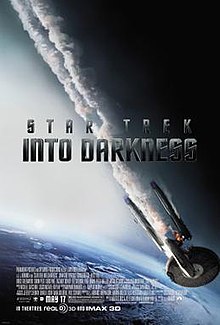
The poster shows a flaming starship falling towards Earth, with smoke coming out. At the middle of the poster shows the title "Star Trek Into Darkness" in dark grey letters, while the production credits and the release date being at the bottom of the poster.

4 stars (out of 4)

Released 2013

I was never a fan of the original Star Trek TV show and I don’t think I ever watched a single episode of The Next Generation or its many offshoots.  But I LOVE these J.J. Abrams reboots.

Having watched some of the classic Trek shows in my childhood, I do remember the characters in a basic sense, but these reboots have built upon these characters in such a creative and engaging way.  And I also love what the lead actors have done with their characters, an even more daunting task considering the responsibility they had to respect the original material.

I think the story in this outing is not as creative as in the first reboot movie, and I think they could have spent a little more time showing us the villain’s supposed dazzling intellect.  But the filmmaker understandably chose to allocate more time to developing the other crew members and mining their relationships for emotional and comedic gold.

Can’t wait to see it again.

Ted

File:Ted poster.jpg

2.5 stars (out of 4)

Released 2012

There were some very funny parts in the first half of this movie and I liked the unexpected way that they handled the magical elements of this story, but the script ran out of gas in the second half.

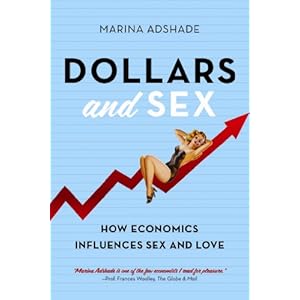
Dollars and Sex

Non-fiction, published 2013, author Marina Adshade

4 stars (out of 5)

The title may give the false impression that this non-fiction work only addresses relationships in terms of exchange of money (it does discuss the topic of prostitution), but this Freakonomics-style book actually attempts to explain how we choose our dating, marriage, and sex partners through the rubric of supply and demand.

In one chapter, armed with data provided by an online dating website, the author analyzes how users choose the partners they do.  What is the influence of race? income? height? beauty?  How do some users sabotage their own chances?

This is a very fast-paced book, with clear and concise summaries of the relevant research, presented in a page-turning fashion, reminiscent of Malcolm Gladwell’s style.  I appreciate that the author was careful to describe the research in such a way that did not distort the findings (eg. the author never makes sloppy conclusions, like mistaking correlation for causation).  My only complaint is that the pace is so fast that I need a second read to fully digest all the interesting facts.

The Sessions

3 stars (out of 4)

Released 2012

Winning performances by John Hawkes and Helen Hunt as thoroughly likeable and relatable characters in this true story of a paraplegic man who hires a sex surrogate.

First Position

3.25 stars (out of 4)

Released 2011

This documentary chronicles the lives of several adolescents (aged 10-17) as they prepare for the World Grand Prix, a prestigious ballet competition with awards that include scholarships to international schools and job offers.

I would have no interest in actually watching a full ballet production, but I have to admit, it was riveting to watch these talented young people.  I actually had to rewatch some of their performances, they were so good.  Maybe the short snippets are more compelling than a full production – it’s more like watching ice skating, which I do like.  Also, seeing the effort that goes into the art and seeing how young some of them are adds to the sense of wonder.

Somewhere Between

3.25 stars (out of 4)

Released 2011

This documentary profiles the lives of 4 American teenagers, all of whom are girls who were adopted from China.  The filmmaker was inspired to make this film after adopting her own daughter from China, and wondering how her daughter will fare in her new life.

The girls discuss some profound issues, like identity and their sense of abandonment, with moving candour.  All 4 girls are quite articulate and thoughtful and come from diverse adoptive families.  The filmmaker also follows two of the girls as they go back to China to search for their birth parents.

Highly recommended – and get your tissues ready.

Fish Tank

2 stars (out of 4)

Released 2009

This independent film, set in a housing project on the outskirts of London, is a portrait of a troubled 15-year old named Mia and shows how she is affected by the arrival of her mother’s new boyfriend, Connor (played by Michael Fassbender).

Because of the film’s slow and deliberate pace, we watch Mia’s ill-advised actions (picking fights, trying to steal a horse, breaking and entering) with the expectation that she has some grander plan that we don’t yet know.

Unfortunately, it seems the movie’s only purpose is a character study of a not-too-bright teen and the disadvantaged circumstances that she is all-too-predictably unable to rise above.

Young Victoria

3 stars (out of 4)

Released 2009

After being impressed with Emily Blunt’s performance in The Jane Austen Book Club, I followed Netflix’s suggestion that I try this movie.

This film focuses on the few years around Queen Victoria’s coronation, including how she chooses her husband and how she learns to hold on to power.  The story is at times told from the perspective of her suitor, Prince Albert, who faces pressure from his uncle, the king of Belgium, to win Victoria over.

Although it’s a fairly straightforward story, I was impressed by the ability of the two lead actors to convince us of their genuine attraction, despite the unromantic fact that their match was strategically convenient.  (And after some Wikipedia surfing, it seems the story is fairly historically accurate.)

The Jane Austen Club

2.5 stars (out of 4)

Released 2007

The concept of this film is that a group of women, plus one lone guy, form a book club dedicated to reading Austen’s novels, and the conceit is that each member’s life mirrors one of the characters in her books.  It’s a cute idea, but because there are so many separate stories to tell, there’s not enough time to properly develop most of them.

Frankly, it’s been a while since I’ve read most of Austen’s novels and I couldn’t remember some of the plotlines well enough to see the parallels with the present-day characters (not that familiarity with the books is needed to follow the movie).  Of the three novels I know well, the parallels were superficial enough that I did not feel that they added any depth to our understanding of the movie characters.

I would have rated this film 2 stars, were it not for Emily Blunt’s performance.  Her character starts out annoying, in a cartoonish sense almost out of sync with the rest of the film, but gradually becomes more and more relatable and sympathetic.

FROM UP ON POPPY HILL

3.5 stars (out of 4)

Released 2011 (in Japan)

This newest offering from Studio Ghibli is currently playing at the TIFF Bell Lightbox in Toronto.  I went to see it with a group of friends, one of whom had originally watched the film when it aired at the TIFFestival last September and was now seeing it for the third time!  We had the choice of watching the film with the English dub, but we elected to go with a Japanese-with-subtitles screening.

The story itself, which takes place in the 1960s, is actually quite simple and consists of two plots.  In the one, the students at a Yokohama high school are working to save their clubhouse from demolition; and the other is about the budding romance between the main girl and boy, Umi and Shun.  Unlike previous Ghibli films, which have tended toward fantasy and whimsy, FROM UP ON POPPY HILL is refreshingly more grounded in reality.

The clubhouse is a grand old building which has fallen into disrepair over the years.  Never have I thought that removing dirt and clutter and fixing up a place could look so fun.  The movie certainly succeeds at showing the wonder and rewards of teamwork.

Umi’s relationship with Shun, developing over the course of their shared activities in helping with the clubhouse, is presented in an unhurried and very believable manner.

At one point, the narrative ventures into somewhat risqué territory.  The consensus among my friends (all adults) was that it didn’t go far enough in that direction.  However, keeping in mind that this is intended to be a family film, I thought the relatively safe conclusion was both appropriate and sufficiently satisfying.  And you know?  I wouldn’t mind seeing the movie again sometime.

Edit (April 12):  Please also read Bini’s comment!
Edit 2: Sadly, all comments have been lost as collateral damage during the great spam purge of Feb 2015.