The Little House

3 stars (out of 4)

Released 2014 (Japan)

A tale of a loving family and a secret romance as recounted in the memoirs of the family’s loyal maid. Most of the film’s events take place around the time of the Second World War. Having the human story in the foreground gave relevance to the depiction of the effects of the war and illustrated what the mindset was like at the time.

The Little House’s narrative unfolded languidly and gave the impression of being very realistic. It was well-acted and convincing, almost making you feel as if you were witnessing a piece of history.

I saw this film 2 days after watching A Tale of Samurai Cooking, also a family drama/love story set in a specific historical period, and it’s hard not to compare the two. I liked the pacing and lighter tone of Samurai Cooking a lot and appreciated that it was remarkably devoid of nastiness, even though it could have easily gone in that direction. Obviously, real life is not like that, so if you like to see realism in your movies, you might be partial to The Little House.

Just that I personally prefer the rose-coloured, feel-good experience of Samurai Cooking.

A Tale of Samurai Cooking – A True Love Story

3.5 stars (out of 4)

Released 2013 (Japan) – Opening night film of 2014 Toronto Japanese Film Festival

A talented young woman named Haru is recruited to marry into a renowned kitchen samurai family so she can help teach the “incompetent” heir to improve his skills. Not only a historical tale of cooking and developing love, there’s also a fair amount of drama, sword-fighting action, political unrest, and even some light-hearted humour at times.

It’s almost worth the price of admission just to see the gorgeous Japanese scenery and beautiful costumes. And of course there’s the food too. It would be wise to eat something before going to see this.

The story developments flow naturally in a well-paced manner. The movie elicits feelings in a way that touches you, rather than hitting you over the head.

Likewise, while the score is noticeably beautiful on several occasions, it fittingly complements the action without being overly dramatic.

If I were to complain about one thing, it’s that the theme song at the end sounds too weird. The female vocal is strangely shrill and just doesn’t sound good. But that’s really a teeny tiny blemish on an otherwise remarkably enjoyable film.

Mid-Spring 2014 Anime Ranking


01. KNIGHTS OF SIDONIA (Sidonia no Kishi) (ep. 1-8) – Really loving this show! Far and away my favourite of the season so far. This frequently brutal and thrilling space opera, about humanity’s struggle for survival thousands of years after aliens, called Gauna, destroyed the Earth, had me hooked by the 3rd episode.

One of the biggest initial challenges was that everyone kind of looks the same. I’m sure it’s completely intentional given the amount of genetic engineering that has occurred, but man, did it ever make it hard to keep track of who’s who, especially in the beginning. The monochromatic colour palette was no help either.

I’m normally not a fan of computer animation, but I have to say it actually works pretty well here. The movements do look a bit stiff occasionally, but really, the narrative is so immersive that none of that bothers me; there’s just no opportunity to dwell on it. I’m really glad I didn’t dismiss this one just because of the CGI.

Anime storylines featuring a boy who shows up and mysteriously has the ability to operate a special mecha are a dime a dozen (eg. Captain Earth, DAIMIDALER, and Dai-Shogun from just this season alone). This show had maybe the most plausible explanation I’ve ever seen – Nagate was raised apart from the population but he practised extensively on a VR simulator all his life. It’s looking like there might be more to it than that, too.

At the close of ep. 8, a Gauna sample has been brought onto Sidonia. I would have done the same thing. Not just because of its familiar appearance, but also because it’s important to study the enemy if you ever hope to understand or defeat them. On the other hand, after all their efforts to keep the Gauna from making physical contact with Sidonia ever again, they now have one on board…

Incidentally, SIDONIA also gets my vote for best OP/ED of the season with its closer “掌 -show-” by Kitamura Eri.
Edit: (streaming on Netflix starting in July)


02. YowaPeda (Yowamushi Pedal) (ep. 26-33) – Onoda has spent the series training and learning about cycling from his peers and his sempai. It’s finally come full circle in ep. 33, as Onoda gets a chance to help Tadokoro by showing him his own special riding technique – and we finally get to hear the Hime Hime song in its entirety!
(streaming at Crunchyroll)


03. Ace of Diamond (ep. 26-34) – In the current arc, Seido is facing off against Yakushi, a formidable opponent, and it’s coming down to a battle of wits between Miyuki and Yakushi’s coach. Furuya, too, is called upon to rise to the challenge. Episode 34 had no shortage of awesome plays. We actually went back and watched several of the scenes over again so we could appreciate them fully!
(streaming at Crunchyroll)


04. Blade & Soul (ep. 1-9) – This show seems to be under the radar for most viewers. Is anyone else watching this?

All the powerful characters in this action-fantasy, be they gang leaders, village chiefs, bosses, good guys or bad, are all female. And why not? Sure, they are all busty and barely dressed, but that doesn’t matter to me, because they are shown to be genuinely strong.

I have nothing against shows with predominantly male characters – check out all the sausagefests in the rest of the top 6 right here – that’s just the way fiction comes. But there’s no denying how refreshing it is to see something with this many strong females in it. Ironically, this program was not made by women, for women. If anything, I think it might be the opposite. Regardless, the creators’ respect for women is very evident in the production.

Maybe that’s part of the reason why this show struggles to find an audience, though. Female viewers see the revealing outfits and assume it’s a show for guys. Meanwhile, many guys have little interest in a show full of warrior women with not even one male for them to fawn over.

Blade & Soul is perhaps also not well-suited for viewers who expect major characters to be overtly expressive. Alka, the lead, is like a killing machine and shows no emotion. As someone who has previously sympathized with strong, silent types in anime, I can personally tolerate Alka just fine; and I’m enjoying the series so far.

Actually, if there’s one thing I could really do without, that would be Karen’s dancing, in the show and in the appalling ED sequence. Now that is some really horrid-looking CGI.
(streaming at Crunchyroll)

05. Haikyuu!! (ep. 1-9) – I seem to be enjoying quite a few sports anime recently. This one’s about volleyball. It took a while for me to warm up to the 2 main guys. Good thing their sempai were so likeable from the start. Especially Tanaka; he’s the best.
(streaming at Crunchyroll)


06. JoJo’s Bizarre Adventure: Stardust Crusaders (ep. 1-9) – Between the elder and the younger JoJo, it’s hard to tell who is the bigger asshole. One is kind of a racist, the other is quite the misogynist, and yet, incredibly, they both manage to come across as funny and endearing!

I never had much interest in the fight sequences (that’s just the way I’m hardwired), so the best part for me is how these creatively over-the–top characters interact with each other. And that’s enough to keep me looking forward to JoJo’s week after week.
(streaming at Crunchyroll)

07. Chaika – The Coffin Princess (Hitsugi no Chaika) (ep. 1-8) – I was really impressed with the first 2 episodes. It seemed like a lot of thought went into the action and the fights. Plus, there was that exploding unicorn, which is definitely not something you see every day, even in anime!

After that, the show has settled into more of a routine action fantasy thing. The execution is still above average, but I find the characters, especially Toru, to be a bit wanting in the personality department.
(streaming at Crunchyroll)


08. The World is Still Beautiful (Soredemo Sekai wa Utsukushii) (ep. 1-8) – Princess Nike of the Principality of Rain moves to the Sun Kingdom for an arranged marriage to young King Livius. Naturally the two butt heads in the beginning, but soon find a common understanding.

I thought the recent episodes involving romantic rivals were a bit tiresome; fortunately they moved on from that fairly quickly.

The series has been a generally pleasant experience, with a couple of notable exceptions. I’m sure I’m not the only one who thinks Nike’s rain-summoning song is horrendously cringe-worthy. And I don’t even remember what the ED sounds like because we skip the sequence every time. It’s too awkward to ogle images of the boy king sleeping in the buff. That just feels wrong.
(streaming at Crunchyroll)

09. Baby Steps (ep 1-9) – The tennis anime. Eiichirou is new to the sport and he approaches it in a highly technical and mathematical manner. It’s rewarding to see his gradual progress.

The drawback: the character designs are ugly. The way Ei-chan’s hair sticks out like a mohawk in the middle of his bangs is really weird. And “pretty girl” Natsu’s super wide eyes sometimes look empty and crazed. It’s kind of scary.
(streaming at Crunchyroll)


10. NO GAME NO LIFE (ep. 1-8) – Legendary brother and sister gamers Sora and Shiro try to take over an alternate world in order to save humanity. This wildly colourful show has its share of pandering and overpowered protagonists, but it frequently succeeds at being imaginative and fun.
(streaming at Crunchyroll)

11. Captain Earth (ep. 1-9) – Insofar as being another anime about a young man and giant mecha, this one is fairly competently made, though far from engaging.

I’d say it’s not in the same league as Star Driver or Eureka Seven, although it is definitely a cut above last season’s Buddy Complex.
(streaming at Crunchyroll)


12. The irregular at magic high school (Mahouka Koukou no Rettousei) (ep. 1-9) – I enjoy reading other people’s (disparaging) post-episode commentaries of this terrible anime so much that there’s no way I’m going to drop it.

It was recently put to me that I followed GUILTY CROWN to the end for the same reason; and that’s a pretty apt comparison, actually. In both cases, the art, character designs, and other superficial aspects are attractive. However, both have unappealing protagonists who expound questionable, rather off-putting social messages. And both series can be entertaining if you’re watching for the unintentional laughs, but otherwise, are quite painful if taken seriously.
(streaming at Crunchyroll)

13. riddle story of devil (Akuma no Riddle) (ep. 1-8) – Unlike last season, in which many series took a while to hit their stride, several shows this time around hit the ground running. Riddle story is one example of a show that started out much better than expected.

However, it has since devolved into a fight of the week scenario. The ending is always the same, too, with the loser just conveniently disappearing. And unfortunately, that seems to be the trend this season, where series might start out strong but then utterly fail to keep up the momentum.

I suppose there will be some big reveal at the end after all the fights are over, but getting there could be a bit tedious. At least the main character is likeable; she’s also of the strong, silent variety, which I apparently admire.
(streaming at FUNimation)


14. ONE WEEK FRIENDS (Isshuukan Friends.) (ep. 1-9) – Hase is determined to be friends with his classmate Fujimiya even though she suffers from a memory disorder. It’s sweet and touching and the kids are cute. I think this anime deserves the praise that it frequently gets; it’s just that I personally find it to be a tiny bit dull. It’s the kind of show that I might forget to watch if I didn’t have it written down on my list.
(streaming at Crunchyroll)

15. NOBUNAGA THE FOOL (ep. 13-21) – Well, if you enjoyed the first half, this cour continues to deliver more of the same. Da Vinci is still playing with his Tarot cards, Mitsuhide still gets an opportunity to flick his hair in practically every episode, and Jeanne continues to be useless and needlessly sexualized.

The OP and ED themes are decidedly not as good this time around, though.
(streaming at Crunchyroll)

16. La corda d’oro -Blue Sky- (Kiniro no Corda: Blue Sky) (ep. 1-9) – Not sure why I’m watching this show. I didn’t even watch the first series. All I can say is it’s harmless and inoffensive. I find it somewhat amusing that they are music students taking part in a musical competition, but they use terminology usually heard in sports anime or war stories. Oh yeah: the best part is the Yokohama scenery.
(streaming at Crunchyroll)


17. BLACK BULLET (ep. 1-9) – This has been pretty consistently mediocre. The visuals are nice, but the pointless monologues and out-of-place boob jokes betray the show’s lack of substance.

The showdown between Rentaro and Tina in ep. 7 was actually thrilling and well-animated. Too bad the resolution was so hokey. Well, it was obvious that Tina would eventually switch allegiances, but still. At one point Rentaro even thanked her for “saving” Enju’s life. Um, she shot her full of bullets and stopped just short of killing her; “spared” her life, I could see, but “saved” is preposterously generous. So in the end, Rentaro, Kisara and Enju, all of them targets of Tina’s prior assassination attempts, welcomed her with open arms. Meanwhile, Tina acted like she was completely guiltless; not even a, “I’m sorry I tried to kill you. It seemed like a good idea at the time.” I guess this is what you can get away with if you’re cute enough. Oh, anime.
(streaming at Crunchyroll)

18. BRYNHILDR IN THE DARKNESS (Gokukoku no Brynhildr) (ep. 1-9) – The initial premise sounded interesting, but when I realized that all the secondary characters were girls, I thought it might be bad. So going in, I expected this show to be haremy and fanservicey. I was pleasantly surprised when I saw that the first 2 episodes were fairly restrained and respectably plot-driven.

However, it’s just gone down from there, to the point where it seemed like 50% of ep 5 was juvenile, unfunny sexual pandering. And that, regrettably, seems to be the pattern that the show has settled into since then.

On the plus side, the other 50% is still decent, which is why I haven’t dropped it yet. And the anime boasts a surprisingly classy intrumental OP. I can’t recommend this show to anyone, though. Some of those icky parts actually make me cringe.
(streaming at Crunchyroll)


19. The Kawai Complex Guide to Manors and Hostel Behavior (Bokura wa Minna Kawaisou) (ep. 1-9) – I came close to dropping this head-scratchingly-titled anime several times. Pretty much nothing happens in it. There are a few funny moments here and there, but I could easily stop watching and not miss it at all, I think.
(streaming at Crunchyroll)

Notable Drop:

MEKAKUCITY ACTORS (ep. 1-4) – Clearly I am not the target audience for this series. I have virtually no prior familiarity with the Kagerou Project’s Niconico music videos. On top of that, I frequently have a very negative visceral reaction to SHAFT aesthetics and animation style.

If I wasn’t watching with my sister, who has a passing interest in Kagerou Project, I would never have made it through 4 whole episodes! I just couldn’t take it anymore after that.
(streaming at Crunchyroll)

FROZEN

3.5 stars (out of 4)

Released 2013

It seriously took me this long to go see this movie. It’s even out on DVD now. I’d been talking about and making plans to see it all these months and things just never fell into place.

For the record, I recall liking “Tangled” quite a bit, but “Brave” didn't really do anything for me. Obviously, I’d heard positive things about “FROZEN”. And I enjoyed it! The computer animation was predictably stunning. The story featured a bit of fantasy, a bit of romance, some politics, some humour, some tragedy, and more than a little sisterly love.

Of course there was music too. In general, I’d say it was nicely incorporated (Disney’s usually pretty good at that) and it didn’t feel awkward that they were suddenly breaking out in song or anything.

Two events in the movie were so heartbreaking, I could have cried.

The weakest parts were the resolution and a certain plot twist, which both happened rather suddenly and conveniently, but I suppose that was necessary in order for things to not drag on too long; children are part of the intended audience, after all.

I recommend watching the credits to the end. Well, the final animated bit is disposable, but the little disclaimer beforehand, in which The Walt Disney Company attempts to distance itself from one of Kristoff’s earlier inflammatory statements, is gold.

The Wind Rises

2.5 stars (out of 4)

Released 2014 in North America (2013 in Japan)

Like other Miyazaki films, The Wind Rises charms the viewer with its pastel landscapes and simple, yet appealing characters.  The script is based on the true story of Jiro Horikoshi, the engineer who designed the bombers that were used by kamikaze pilots in WWII.

It was pleasant to watch but, in the end, turned out to be a very straightforward story about a rather ordinary man, who is never depicted as having to make tough choices, since at each fork in his road, he seems to feel that he essentially has no choice.

I felt that there were some hints early on in the film that serious and politically sensitive topics, such as the morality of the use of violence and perhaps a reckoning on the responsibility a creator has for how his designs are ultimately used, were going to be addressed.  But the filmmaker seems satisfied to limit his exploration of these issues to a few cranky remarks made by Jiro’s cynical and snarky best friend.  To be fair, I don’t know if these issues could be addressed in any satisfying way, but the way the movie flirts with these topics and then drops them is a needless disappointment.

For a while, it looked like the movie was going to dramatize how Jiro came up with his innovations or show us how brilliant they were relative to the technology of the time – in which case, I was getting ready to give kudos to the filmmaker for tackling the difficult challenge of making engineering both interesting and understandable for the lay public.  (This is definitely a difficult but not impossible feat because the rare movie has accomplished this in the past, Apollo 13 being a shining example.)  But no, disappointed again.

I must credit the excellent voice acting (I saw the English dub, with Joseph Gordon-Levitt playing the lead) for giving way more personality to the characters than would have been expected from their rather mundane lines and also for making me enjoy this movie on an emotional level despite feeling kind of irritated at it on an intellectual one.

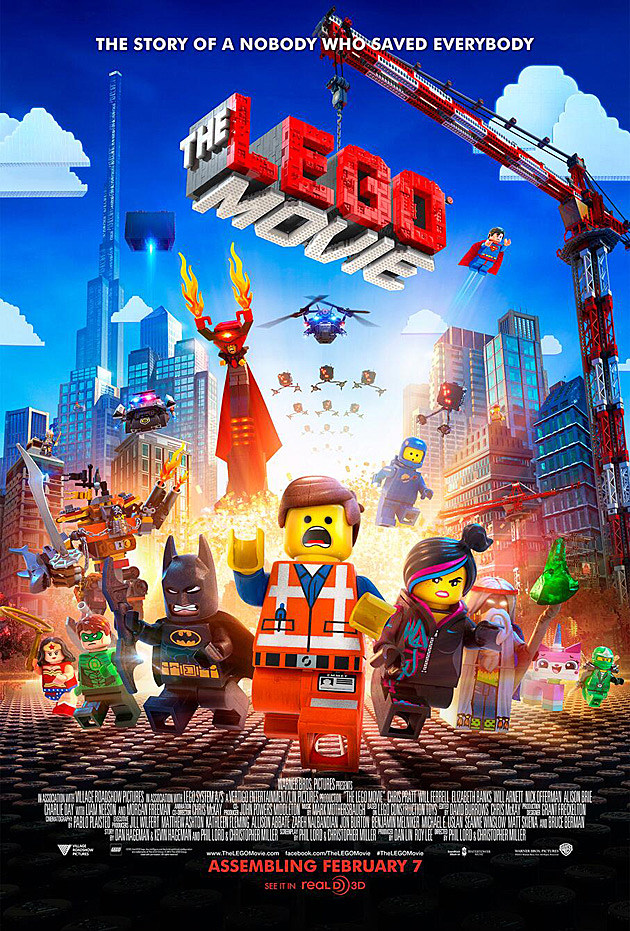
The LEGO Movie

3.25 stars (out of 4)

Released 2014

The first three-quarters of this movie plays as an enjoyable, kinetic, somewhat random ride, with cameo appearances from multiple LEGO-affiliated franchise characters, and more than a little borrowing from The Matrix for its plot and main characters.

I was ready to dismiss it as a 2.5 star effort, with a few funny moments, but no really inspired message.  However, near the end, a larger plot is revealed which cleverly explains the randomness in the earlier parts of movie and also happens to carry a rather profound message uniquely relevant to LEGO’s multi-generational appeal.

Yeah, that’s how good the twist is.  I will say no more.

Mid-Winter 2014 Anime Ranking

Can I just make a list of my favourite theme songs this season? Because that would be so much easier:

1. AXIS, by STEREO DIVE FOUNDATION (NOBUNAGA The Fool ED)
2. Respect for the dead man, by Pay money To my Pain (NOBUNAGUN OP)
3. With You / With Me, by 9nine (MAGI: The Kingdom of Magic ED2)
4. Goya no Machiawase, by Hello Sleepwalkers (NORAGAMI OP)
5. FANTASTIC TUNE, by Ono Kensho (Kuroko’s Basketball 2 ED2)

Guess not, eh? The thing is, fully half the shows I’m following currently were middling carryovers from last season. The other half debuted in January; and it seems like practically every one of these new shows is taking forever to get moving plot-wise. So I find myself in a position where I’m not particularly enthusiastic about anything on my watch list. Anyway, here goes.


01. MAGI: The Kingdom of Magic (ep. 13-21) – After a seriously underwhelming first cour, MAGI has gotten back on track in a big way. We’re now familiar with the 3 main nations (the Kou Empire, the Leam Empire, Magnoshutatt) that have begun to clash. While the main focus has been on Aladdin’s experiences in Magnoshutatt, we’ve seen that all 3 of the factions have grand and worthy ideals. And true to MAGI fashion, we’ve also seen that each side can be criticized for transgressions they are willing to make in the name of those ideals. To top it off, there exists some discontent within each group as well. These kinds of complex and balanced portrayals are what impress me the most about this franchise.
(streaming at Crunchyroll)


02. YowaPeda (Yowamushi Pedal) (ep. 13-21)
03. Ace of Diamond (ep. 14-22)
04. Kuroko’s Basketball 2 (ep. 38-47) – In a stronger season, these 3 sports anime probably wouldn’t rank so highly. None of these shows really explore the characters’ personal lives or their interests/relations outside of the sport, which is something I’d like to see. For what they are though, with the focus on training and competing/playing games, the stories are competently told and each episode is consistently enjoyable to watch.
(all 3 streaming at Crunchyroll)


05. NORAGAMI (ep. 1-9) – NORAGAMI is generally well put-together; the 3 leads are interesting characters, especially Yukine. However, I can’t help but feel the show is being excessively cryptic about Yato’s past. It’s hard to feel the intended impact of current events when we know so little of why they are significant relative to the character’s history and present situation.
(streaming at FUNimation)

06. TOKYO RAVENS (ep. 13-21) – This second cour has the story moving out from the core group to expand on the greater story. Unfortunately, it’s pretty convoluted. And it isn’t easy to keep track of the growing cast, especially as some of them are reincarnations of other characters.
(streaming at FUNimation)

07. SPACE DANDY (ep. 1-9) – Completely episodic. So far it doesn’t matter what order you watch the episodes in since the show doesn’t even pretend to have any continuity concerns. Of course, that allows for a lot of creativity and it is frequently pretty fun and amusing to watch. My favourite episode of what I’ve seen is the ingenious fourth one, with the zombies. They really went all out with that one; every time it seemed like it had to be all over, they found a way to take it further!
(streaming at FUNimation)


08. NOBUNAGUN (ep. 1-10) – I’m enjoying the primary characters, including lead girl Sio/Nobunagun, who is quirky in an appealing way. That makes the series fun to watch. However, the main Pacific Rim-like plot line is not very inspiring. The Evolutionary Invasion Objects seem so powerful that I don’t see how DOGOO has any reasonable chance of defeating them, even with their E-Gene Holder forces.

One of the giggle-inducing highlights for me was the random swimsuit dream sequence from ep. 8, in which Jack (Suzuki Tatsuhisa) threw his arm around Gandhi (Shimazaki Nobunaga) after declaring their relationship as lovers. Too funny! (edit: Sorry, it might not be obvious that I interpreted this as a MakotoXHaru Free! reference.)
(streaming at Crunchyroll and FUNimation)

09. KILL la KILL (ep. 13-21) – Thankfully the various battles and power-ups are done and we are finally into the meat of the story starting with episode 16. The revelations since then have been meaningful and the fights have felt consequential. I’m pretty impressed with the novel theory of evolution that KILL la KILL is adhering to – I’ve definitely never heard anything like that before. More and more, it’s becoming evident how smart the series is and how it’s been consistent with its internal logic from the start.
(streaming at Crunchyroll)


10. Witch Craft Works (ep. 1-9) – The best thing about Witch Craft Works is how crazy funny it frequently is, right down to the irreverent ED sequence which moe-fies the historical persecution of witches for laughs. The atypical roles (the guy is the “princess”, while the girl is the strong protector) are also refreshing. Unfortunately, both the main characters are pretty bland otherwise, and that keeps me from really getting into the series. That, and they’re constantly throwing in too many new players, and I can’t keep them all straight.
(streaming at Crunchyroll)

11. Space Brothers (Uchuu Kyoudai) (ep. 88-97) – I haven’t been all that interested in Mutta’s experiences with his grating new team members. The touching episode about Eddie Jay, hit the mark, though. Now, Hibito is finding himself being stigmatized for having suffered a psychological disorder; I give the show credit for how realistic that is.
(streaming at Crunchyroll)

12. PHI BRAIN – Kami no Puzzle Season 3 (ep. 14-23) – After two and a half seasons of Kaito and company tackling killer puzzles and emerging largely unscathed, it came as a surprise that there has now been a fatality – a welcome surprise, because come on!

If Kaito’s friends end up dying one after another now, and he obtains the ultimate power and turns back time to bring everyone back to life, I’m going to be really, really disappointed. Dead people should stay dead or it’s cheap storytelling.
(streaming at Crunchyroll)


13. NAGI NO ASUKARA (Nagi-Asu: A Lull in the Sea) (ep. 14-22) – So the sea kids are waking from their slumber after 5 years. There is still a threat of global catastrophe somewhere in the future. And the mildly melodramatic polygonal romantic angst continues.
(streaming at Crunchyroll)

14. The Pilot’s Love Song (ep. 1-10) – The darker, more serious flashback sequences are pretty good, but the lighter present story… leaves something to be desired. This is another show that’s not forthcoming enough with its basic setup. What is Isla’s goal? Where are they going exactly? Why are they even at war?
(streaming at Crunchyroll)

15. BUDDY COMPLEX (ep. 1-9) – I can understand that there’s going to be some mystery about how and why Aoba got transported to the future, but I would think that by now there’d be some explanation of the conflict that’s currently going on. Who are the Free Treaty Alliance and the Great Zogilia Republic and what are they fighting for? Never mind the audience, why doesn’t Aoba ask?
(streaming at FUNimation)


16. NOBUNAGA THE FOOL (ep. 1-9) – What I don’t like: Tarot cards. It’s fine if they’re just used for artistic effect. But when a character actually pulls out the cards and that’s what regularly passes for plot advancement, forgive me if I’m a little skeptical of the narrative integrity.

The two-worlds plot is so nonsensical, or at least so insufficiently explained, that even though da Vinci delivered that lengthy infodump in ep. 8, I still feel we didn’t learn anything!

It also bothers me that all the women are useless. Especially Nobunaga’s sister. She just stands there like a non-player character in a game, singing, until approached, at which point she’ll divulge a little information and then go back to singing.

What I like: Mitsuhide’s hair, which is almost a character on its own. It’s great the way the animators lovingly render every strand that falls across his eyes, and every lock that’s casually brushed away from his face. It’s so absurd, it’s awesome.
(streaming at Crunchyroll)

17. Samurai Flamenco (ep. 12-19) – Episode 18 was surprisingly, hilariously crack and actually offered an explanation of the events so far. It may not have been the best episode to date (probably ep. 2 would take that honour), but it was certainly the funniest. That said, it still doesn’t make up for all the time-wasting, plot-twisting dreck I was suckered into watching for the preceding 11 episodes! Well, it’s not over yet; let’s see what they have in store for us in this final stretch.
(streaming at Crunchyroll)
18. Wizard Barristers (ep. 1-7) – This show is about lawyers who try to protect the rights of magic users in a society where the use of magic is against the law. The unintended irony is that these lawyers can’t seem to get anything done without resorting to magic themselves! What are they trying to say exactly?

Also, I can’t relate to Cecil at all. Even her character design is annoying. It should be a really cool thing that an anime protagonist is Canadian, but instead, it’s disappointing at best, mortifying at worst. I was only following Wizard Barristers because my sister was still watching it; now that she’s sufficiently exasperated and also ready to drop, I doubt I will stick around see if this incompetent narrative actually goes anywhere.
(streaming at Crunchyroll)

Also watching:

Tonari no Seki-kun: The Master of Killing Time (ep. 1-10) – A 6-minute (without credits) short about a schoolboy who continually goofs off in elaborate ways during class. The girl who sits beside him struggles with feelings of disapproval and fascination at witnessing his antics.

Every once in a while, they change things up a bit by involving another student, which is good.
(streaming at Crunchyroll)


Pupa (ep.1-9) – Since it’s a 3-minute short, you’d expect things to move at a brisk pace. Not so with Pupa. It just takes its time unraveling its horror story as if it were a full-length show, only to end abruptly. One episode consists solely of the brother being slowly devoured by his sister; another is all him howling in pain off-screen as he is undergoing surgical evaluation.

We initially put Pupa on hold after 2 episodes, then returned to marathon up to ep. 9 all at once, which is definitely a better way to approach this. We will finish watching – it’s a very small time commitment after all – once it is complete.
(streaming at Crunchyroll)

anohana THE MOVIE: The Flower We Saw That Day

3 stars (out of 4)

Released 2013 (in Japan)

Taking place a year after the events of the 2011 TV series, the anohana movie expands on the group’s past through the eyes of each surviving member as they compose letters to their lost friend, Menma.

This film is comprised of a significant amount of reused footage interspersed with new material. In spite of this, it is recommended to watch the series first, as it can be difficult to tell which scenes are from the past and which are in the present if you are not already familiar with the story. And, there’s no straightforward recap about Menma’s death or how her return as a ghost brought the Super Peace Busters back together, either.

All in all, I found the film to be a satisfying continuation of the series. It was a nice way to revisit these old friends. While I personally had no trouble remaining dry-eyed throughout, be aware that this movie can be quite the tearjerker for more sensitive viewers.

her

3.5 stars (out of 4)

Released 2013

Even though it’s not likely I’ll feel compelled to re-watch this film, I’m going to be generous and bump it up to 3.5 stars for its well-written script. While addressing issues related to being involved in an unconventional romance, the movie successfully painted a complex picture of the evolution of a relationship over time.

Human beings are ever-growing, ever-changing creatures. And the impact that has on interpersonal relationships is pretty universal. Members of any partnership ultimately face the same ups and downs, the same challenges of trying to understand one another. “her” aptly demonstrated these aspects while following a natural flow.

I also liked how small changes in thought processes were shown to have significant effects on mood and psychological wellbeing.

Jacquie’s 2013 Year in Review – Top 10 Anime

Better late than never, here are my favourite anime shows of the past year, selected from the 45 or so titles I watched in entirety which finished airing in 2013:


#1. Attack on Titan (Shingeki no Kyojin) – This was the anime that really did capture my imagination. I looked forward to it week after week and it rarely disappointed. I was inspired to think about the mystery of the titans and to understand the motivations of the characters long after watching each episode. It also provided an ideal vehicle to showcase soundtrack composer Hiroyuki Sawano’s epic score, which was a perfect complement to the show.

The downside was that there was no conclusive ending; all the big questions remained unanswered at series-end. Also, at times the pacing was rather slow as some plot segments dragged on a little longer than necessary.

No sequel has been confirmed yet, but Attack on Titan enjoyed enough popularity, even beyond the usual anime fanbase, that we’ll certainly see one someday.


#2. The DEVIL is a Part-timer! (Hataraku Maou-sama!) – The series that got my highest rating of the year over at MAL, for its sharp humour, well-paced storytelling and lovable characters. The premise was pretty simple: Satan (Maou) and his subordinate found themselves magically stranded in modern-day Tokyo. They had no resources left to get home, so they had to do their best to make a life for themselves in the big city, including getting a job at MgRonald’s. It was brilliantly funny stuff.

The comedy wasn’t based on crazy hijinks, either. Instead, it was found in the day-to-day details that anyone who’s had to get used to a new environment or who’s had to work hard to make ends meet could relate to, with the added absurd spin that our protagonist was the devil himself, of course.

The negatives: no conclusive ending here either; also, the humour might work better on an audience with some prior familiarity with modern working class Japanese culture, with its references to 100yen shops and UNIQLO, for instance.


#3. Free! – Iwatobi Swim Club – My choice for the most rewatchable anime of the year. My sisters are Free! fangirls, so I have seen each episode several times, and you know, it really does stand up to repeated viewings.

Free! didn’t have the epic storyline of Attack on Titan, or the clever humour of Maou-sama, but it was very nicely animated, it had extremely well-developed characters and great execution overall.

Season 2 has now been confirmed and I couldn’t be more pleased.


#4. Shin Sekai Yori (From the New World) – An intriguing story featuring a novel future setting, Shin Sekai Yori started strong in its first half. I felt it lost some focus during the second cour, but then the series came to a satisfying conclusion in its impressive final episode.

Along the way, the series’ faults were considerable: slow pacing in parts, inconsistent character art, weak main protagonist – I kept waiting for Saki to become the great, enlightened leader she was chosen to be, but it never happened.

Despite all that, the depiction of the darkness of human nature was a compelling theme. And this was a rare instance where an anime’s ending actually elevated my overall estimation of a show.


#5. PSYCHO-PASS – Some of the grotesquerie from the first cour was a bit of a turn-off for me. The show really picked up in the second half, though, offering interesting ideas and complex characters, including female lead Akane. All in all, the storytelling and pacing were good; and in spite of the dark theme, it was a fun series to watch.


#6. Chihayafuru 2 – I admit, I was not as enamored with this season as I was the first, but I found it solidly entertaining regardless. I loved the characters, and the series never bored me, even with the greater focus on Karuta gameplay.


#7. The Eccentric Family (uchouten-kazoku) – uchoten-kazoku featured a close-knit family of tanuki still coming to grips with things in the wake of losing the father, who died unceremoniously before the events of the series. Simultaneously magical, quirky, charming, and darkly humorous, the narrative was strongest and most heart-warming when the focus was on the very human characters (even though they weren’t human) of the main tanuki family.


#8. Valvrave the Liberator (Kakumeiki Valvrave) – Valvrave started out as an over-the-top action anime featuring a crazy mash up of mecha, high school, political intrigue, and vampire elements. It got away with a lot of ridiculousness by being clearly self-aware. But the story was never a joke. I think the show managed to achieve a good balance between the silliness and the seriousness.

In general, the large cast had impressively well-defined personalities. And L-elf was particularly entertaining, with his freakish smarts and unhesitating brutality, providing a good foil for main character Haruto’s earnest idealism.


#9. Kyousougiga – What made this series work were the great characters and their relationships with each other. Even though the setting and happenings were crazy and surreal, the show was grounded in the sympathetic members of the central family. The end result was a positive, life-affirming, feel-good experience.


#10. Ginga Kikoutai Majestic Prince – This anime had a fair amount of satire and goofiness, much of it at the expense of the main characters, the members of Team Rabbits, AKA Fail Five. In particular, lovably dorky leader Izuru and boy-crazy Tamaki led the way for much of the humour. The show also featured a very convincing portrayal of GERD, and I felt for Asagi whenever his stomach acted up.

Ultimately though, Majestic Prince functioned reasonably well as a serious story about the protecting of humanity from alien threat. And finally, I can’t not mention the frequently impressive mecha battle sequences this show had; even a mecha-ignorant viewer such as myself could appreciate how good they were.
____________________________________________________________________

Biggest Regrets: Series that, in retrospect, I probably shouldn’t have bothered watching from beginning to end. Listed in approximate broadcast order with brief comment.

  • MAOYU (groan)
  • Love Live! School idol project (yawn)
  • RDG Red Data Girl (incomprehensible)
  • DEVIL SURVIVOR 2 The Animation (groan)
  • Arata the Legend (Arata Kangatari) (yawn)
  • GATCHAMAN CROWDS (incomprehensible)
  • BEYOND THE BOUNDARY (Kyoukai no Kanata) (whatever)
  • Galilei Donna (groan)