The Snow White Murder Case

3 stars (out of 4)

Released 2014 (Japan) – Closing night film of 2014 Toronto Japanese Film Festival

At the base of the story is a classic whodunit that arises when a beautiful office worker is brutally murdered. Instead of focusing on the police investigation, the film explores the spreading of information and misinformation through irresponsible news reports and the prevalent use of social media.

A few provocative tweets can affect the public’s perception of a person. And innocent past events can suddenly seem damning if you are suspected of committing a crime.

In this day and age of hurtful and judgemental internet comments by anonymous users, The Snow White Murder Case serves as a reminder that we need to keep an open mind and not assume that everything we might believe to be true is actually the truth.

JUDGE!

2.5 stars (out of 4)

Released 2014 (Japan)

Representatives from a number of advertising agencies convene for the Santa Monica International Advertising Festival. There’s wheeling-and-dealing and politicking, as the participants try to get votes for their own company’s ad, often resorting to blatantly dishonest methods. Jobs and reputations are on the line.

For the most part, the movie was entertaining enough to watch and certainly had its funny moments. Ultimately, though, I didn’t really buy into the story. The proceedings just seemed too exaggerated. By the time the main character launched into his speech about being true to oneself, I kind of felt like laughing, even though that part was not meant to be funny.

Also, although it was probably not intended to be offensive, I do think they went too far with the stereotypical depiction of gays in the film.

WHY DON’T YOU PLAY IN HELL?

2.5 stars (out of 4)

Released 2013 (TIFF Encore Presentation)

Amid ongoing gang wars, a yakuza boss’s wife is about to be released from jail after doing time for murder. He has promised to show her a movie with their daughter as the star. Meanwhile, there’s a group of amateur filmmakers who are willing to lay down their lives in the service of creating the ultimate action flick.

WHY DON’T YOU PLAY IN HELL? is bloody, crazy violent, and also absurdly funny. The characters are surprisingly likeable, as well, despite being a bunch of murderous gangsters and idiots.

At the end of the day, though, I kind of hoped that there would be a point to all the carnage, some more plot, if you will, but there was not.

Don’t get me wrong; I still enjoyed the film. I think I had a smile on my face the entire time except when I was wincing at the butchery – and sometimes it might have been both at once. Taken as an unrestrained celebration of glorious, comedic violence, the film is a rousing success.

Black Butler (Kuroshitsuji)

3 stars (out of 4)

Released 2014 (Japan)

I attended back to back screenings of Black Butler and The Little House. In both films, a member of the hired help is in the lead role and the family business is toy making. Aside from that, the two could not be more different. While The Little House is a serious historical drama, Black Butler is an action thriller with a healthy dose of comedy.

Considering the fantasy aspect of the demon manservant, Black Butler plays out much like a Hollywood superhero movie. Sebastian and his master, Kiyoharu, take on a complicated murder mystery. Along the way, they encounter plenty of intrigue and action, including some impressive gun-fight and sword-fight sequences. Well, Sebastian usually wields silverware; he is a butler, after all.

Hiro Mizushima turns in an excellent performance as the titular butler. Just by narrating a few lines early on, it is subsequently easy to tell what Sebastian is thinking from only subtle changes of his expression.

All in all, I found the movie to be delightfully campy and fun.

The Little House

3 stars (out of 4)

Released 2014 (Japan)

A tale of a loving family and a secret romance as recounted in the memoirs of the family’s loyal maid. Most of the film’s events take place around the time of the Second World War. Having the human story in the foreground gave relevance to the depiction of the effects of the war and illustrated what the mindset was like at the time.

The Little House’s narrative unfolded languidly and gave the impression of being very realistic. It was well-acted and convincing, almost making you feel as if you were witnessing a piece of history.

I saw this film 2 days after watching A Tale of Samurai Cooking, also a family drama/love story set in a specific historical period, and it’s hard not to compare the two. I liked the pacing and lighter tone of Samurai Cooking a lot and appreciated that it was remarkably devoid of nastiness, even though it could have easily gone in that direction. Obviously, real life is not like that, so if you like to see realism in your movies, you might be partial to The Little House.

Just that I personally prefer the rose-coloured, feel-good experience of Samurai Cooking.

A Tale of Samurai Cooking – A True Love Story

3.5 stars (out of 4)

Released 2013 (Japan) – Opening night film of 2014 Toronto Japanese Film Festival

A talented young woman named Haru is recruited to marry into a renowned kitchen samurai family so she can help teach the “incompetent” heir to improve his skills. Not only a historical tale of cooking and developing love, there’s also a fair amount of drama, sword-fighting action, political unrest, and even some light-hearted humour at times.

It’s almost worth the price of admission just to see the gorgeous Japanese scenery and beautiful costumes. And of course there’s the food too. It would be wise to eat something before going to see this.

The story developments flow naturally in a well-paced manner. The movie elicits feelings in a way that touches you, rather than hitting you over the head.

Likewise, while the score is noticeably beautiful on several occasions, it fittingly complements the action without being overly dramatic.

If I were to complain about one thing, it’s that the theme song at the end sounds too weird. The female vocal is strangely shrill and just doesn’t sound good. But that’s really a teeny tiny blemish on an otherwise remarkably enjoyable film.

FROZEN

3.5 stars (out of 4)

Released 2013

It seriously took me this long to go see this movie. It’s even out on DVD now. I’d been talking about and making plans to see it all these months and things just never fell into place.

For the record, I recall liking “Tangled” quite a bit, but “Brave” didn't really do anything for me. Obviously, I’d heard positive things about “FROZEN”. And I enjoyed it! The computer animation was predictably stunning. The story featured a bit of fantasy, a bit of romance, some politics, some humour, some tragedy, and more than a little sisterly love.

Of course there was music too. In general, I’d say it was nicely incorporated (Disney’s usually pretty good at that) and it didn’t feel awkward that they were suddenly breaking out in song or anything.

Two events in the movie were so heartbreaking, I could have cried.

The weakest parts were the resolution and a certain plot twist, which both happened rather suddenly and conveniently, but I suppose that was necessary in order for things to not drag on too long; children are part of the intended audience, after all.

I recommend watching the credits to the end. Well, the final animated bit is disposable, but the little disclaimer beforehand, in which The Walt Disney Company attempts to distance itself from one of Kristoff’s earlier inflammatory statements, is gold.

The Wind Rises

2.5 stars (out of 4)

Released 2014 in North America (2013 in Japan)

Like other Miyazaki films, The Wind Rises charms the viewer with its pastel landscapes and simple, yet appealing characters.  The script is based on the true story of Jiro Horikoshi, the engineer who designed the bombers that were used by kamikaze pilots in WWII.

It was pleasant to watch but, in the end, turned out to be a very straightforward story about a rather ordinary man, who is never depicted as having to make tough choices, since at each fork in his road, he seems to feel that he essentially has no choice.

I felt that there were some hints early on in the film that serious and politically sensitive topics, such as the morality of the use of violence and perhaps a reckoning on the responsibility a creator has for how his designs are ultimately used, were going to be addressed.  But the filmmaker seems satisfied to limit his exploration of these issues to a few cranky remarks made by Jiro’s cynical and snarky best friend.  To be fair, I don’t know if these issues could be addressed in any satisfying way, but the way the movie flirts with these topics and then drops them is a needless disappointment.

For a while, it looked like the movie was going to dramatize how Jiro came up with his innovations or show us how brilliant they were relative to the technology of the time – in which case, I was getting ready to give kudos to the filmmaker for tackling the difficult challenge of making engineering both interesting and understandable for the lay public.  (This is definitely a difficult but not impossible feat because the rare movie has accomplished this in the past, Apollo 13 being a shining example.)  But no, disappointed again.

I must credit the excellent voice acting (I saw the English dub, with Joseph Gordon-Levitt playing the lead) for giving way more personality to the characters than would have been expected from their rather mundane lines and also for making me enjoy this movie on an emotional level despite feeling kind of irritated at it on an intellectual one.

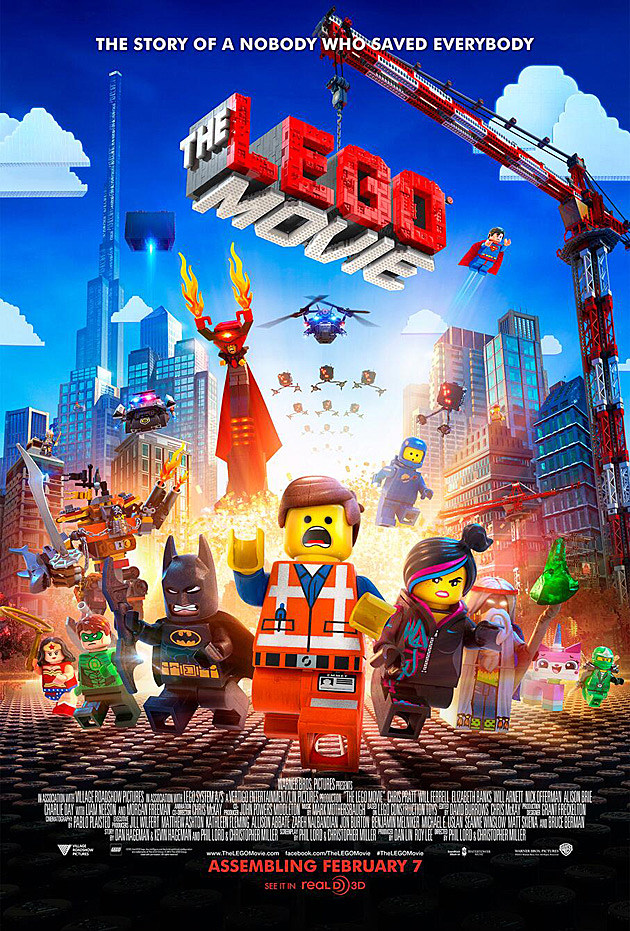
The LEGO Movie

3.25 stars (out of 4)

Released 2014

The first three-quarters of this movie plays as an enjoyable, kinetic, somewhat random ride, with cameo appearances from multiple LEGO-affiliated franchise characters, and more than a little borrowing from The Matrix for its plot and main characters.

I was ready to dismiss it as a 2.5 star effort, with a few funny moments, but no really inspired message.  However, near the end, a larger plot is revealed which cleverly explains the randomness in the earlier parts of movie and also happens to carry a rather profound message uniquely relevant to LEGO’s multi-generational appeal.

Yeah, that’s how good the twist is.  I will say no more.

anohana THE MOVIE: The Flower We Saw That Day

3 stars (out of 4)

Released 2013 (in Japan)

Taking place a year after the events of the 2011 TV series, the anohana movie expands on the group’s past through the eyes of each surviving member as they compose letters to their lost friend, Menma.

This film is comprised of a significant amount of reused footage interspersed with new material. In spite of this, it is recommended to watch the series first, as it can be difficult to tell which scenes are from the past and which are in the present if you are not already familiar with the story. And, there’s no straightforward recap about Menma’s death or how her return as a ghost brought the Super Peace Busters back together, either.

All in all, I found the film to be a satisfying continuation of the series. It was a nice way to revisit these old friends. While I personally had no trouble remaining dry-eyed throughout, be aware that this movie can be quite the tearjerker for more sensitive viewers.