DJANGO UNCHAINED

3 stars (out of 4)

Released 2012

This western-actioner is pretty much what one would expect from a Quentin Tarantino film.  It manages to be smart and dumb at the same time and there’s no skimping on gore.  It takes place in the American deep south a couple of years before the Civil War.  Like LINCOLN, it covers the topic of slavery, although the 2 films couldn’t be more different in terms of presentation and tone.

Christoph Waltz and Jamie Foxx deliver strong performances in their roles of dentist-turned-bounty hunter Dr. King Schultz and his eventual partner, slave-turned-bounty hunter Django.  Django’s ultimate goal is to rescue his wife Broomhilda from the Candieland plantation, but there’s a lot of character- and plot-development enroute.

DJANGO UNCHAINED is brutally violent, with copious amounts especially toward the end.  Fortunately, it is frequently amusing too.  Just one example: a pre-raid meeting held by the white supremacists in which they air their grievances about the headgear they are supposed to wear.

Going in, the running time of nearly 3 hours gave me pause, but ultimately, the movie didn’t end up feeling too long.

(On a side note, seeing Dr. Schultz’s cute horse made me nostalgic for another cute horse: Comet, from The Adventures of Brisco County Jr.)

Beasts of the Southern Wild

3.25 stars (out of 4)

Released 2012

I can’t write about this movie without revealing major spoilers, so be forewarned.

This movie didn’t go where I expected it to go, and the direction it took is not entirely satisfying but did make me think.

It starts out as a survival story about a six-year-old girl, just abandoned by her alcoholic father in an isolated and impoverished community on an island outside of the levees that keep the rest of civilization dry and safe.  The film is intentionally opaque about whether this is meant to be modern times, outside of New Orleans, circa Katrina, or whether this is meant to be a post-apocalyptic time in the near future (I guessed the latter, at first).  They show how this community has developed its own culture which values toughness and celebrates what little they have, and how the little girl has internalized those lessons.

At this point, it is hinted that they would be captured and put into camps if they ever dared to venture behind the levees, so they are essentially trapped in the flooded wilderness.  It was harrowing to watch the girl try to fend for herself, and even when her father returns, they continue to suffer as another hurricane batters and floods their island.  I kept hoping for some happy ending that would see the girl finally safe and well-cared for, despite the fact that things looked like they were going from bad to worse.

Then, they are visited by rescue workers who bring them and their neighbours, against their will, to a refugee camp where they are given food, clothing, medicine, and schooling.  But they (with their neighbours) plot an escape back to their island.  Huh?

Up to this point, at particularly lonely times, the girl would heartbreakingly cry out for her mother, who abandoned her as a baby.  So, after returning to their bleak makeshift home and finding out that her father is dying of an unspecified disease, she sets out on a raft, and somewhat miraculously finds someone who seems to be her mother.  This woman even offers to let her stay with her.  But she chooses to go back the island.  Huh?

The ending was a bit of a non-ending, actually, in that the girl simply continues to struggle on, just as she did in the beginning of the movie, but now, she has chosen this path.

So basically, this movie ends up being a chronicle of one alternative lifestyle, where people choose poverty and danger when safety and resources are close at hand.  I feel that using the term “alternative” is already being generous, because what reasonable person would choose this?  Not to mention the ethics of choosing it for your child.  I could see that the filmmaker was trying to frame the ending as a celebration of embracing the life you already have.  I just wasn’t entirely convinced, and started to feel less and less sorry for these people as the movie went on.  And that’s kind of the point of the movie too:  this little girl doesn’t want your pity.

The Perks of Being a Wallflower

3 stars (out of 4)

Released 2012

A coming-of-age story about an awkward high school freshman (just released from a mental hospital) who is taken under the wings of a pair of fun-loving but troubled seniors.

Realistic characters and good acting distinguish this film from other high school movies, although it does explore familiar themes.  I thought the director/writer did a tasteful job of not sensationalizing the main character’s mental illness.

Silver Linings Playbook

2.5 stars (out of 4)

Released 2012

This is a generally competent romantic comedy/drama but lack of chemistry between the leads and a somewhat random ballroom dance subplot prevented the film from being great.

I say random, because I couldn’t see why Jennifer Lawrence’s acid-tongued character would also be obsessed with amateur ballroom dancing, other than the fact that it gave the main characters a reason to keep meeting for practice.

There were some funny moments involving Robert DeNiro as the superstitious football-fan dad, but in general I think this film is highly over-rated.

CHRONICLE

2.5 stars (out of 4)

Released 2012

Three teenagers stumble upon an underground cave and encounter something which mysteriously gives them the power of telekinesis.  These are regular boys, not superheroes, and they do not have any exceptional maturity or mental stability to help them handle their newfound “great power”.  We follow them as they experiment with and learn to use their abilities and eventually see the effect they have on the outside world.

There’s the added gimmick of the movie being seen through the lens of a home-video camera and it’s mostly effective and creatively-used, and doesn’t detract from the story.

Coincidentally, CHRONICLE can function as an origin story for the ongoing anime series Shin Sekai Yori (From the New World), which imagines what the world will be like hundreds of years after some of the population acquire telekinesis and become a threat to humanity.  More on that later, maybe…


The Hobbit

File:The Hobbit- An Unexpected Journey.jpeg

3.5 stars

(released 2012)

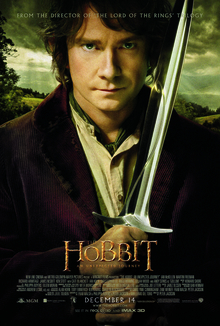
It’s wonderful to see another beloved Tolkien novel brought to life on the screen under the thoughtful direction of Peter Jackson.  This film is visually, aurally, and tonally continuous with the Lord of the Rings series, although the material tends to be lighter than LOTR (which is consistent with the source material).

Martin Freeman is spot-on as Bilbo Baggins – in fact it’s hard to imagine a better casting choice.  Andy Serkis’ Gollum is simply perfection and the rendering of the “Riddle game” sequence is just like the book come to life (and I mean that in the best way, not that it was just a word-for-word re-creation of the novel).

The concerns about Jackson’s decision to stretch the series out to make a trilogy appear to be unfounded, based on the pacing of this first episode.  Material added in to flesh out the dwarves’ history and to dramatize some of Gandalf’s manoeuvring are entirely appropriate.  Jackson and his writing team have consistently made good choices about adapting the books to the screen, both in terms of what to edit out and what to add in for better movie-story-telling.

A couple of relatively minor complaints:  I saw this film in 3D and 48 frames per second (the way Jackson wants it to be seen) and it definitely was a detriment to the movie-going experience, especially during the indoor scenes.  The lighting seemed artificial and I was acutely aware of camera movements.  The 3D effect made the characters who were in close-up look like they were standing in front of a flat background.  I definitely recommend seeing this in 2D and traditional 24 frames per second.

Also, I was a little disappointed that they did not introduce more new theme songs – I think they only added one new Lonely Mountain theme (which basically replaces the Fellowship theme) and recycled the Shire theme and the Rivendell theme.  I know they wanted to establish continuity with the LOTR films, but I thought hearing so much of the same music was off-putting.

Skyfall

3 stars

(released 2012)

Skyfall is a solid entry in the Bond canon with an interesting baddie (Javier Bardem – wow, that guy can act!) and a welcome focus on Judi Dench’s M.  There were some nice bits of humour, which helped to flesh out the relationship between Bond and M.  The last act, involving a shoot-out in an abandoned mansion, seemed a little under-developed (they would really go hide out somewhere and bring no weapons with them?), and I was hoping they would reveal a little more backstory into Bond’s origins.  Still, overall, an entertaining, exciting action flick.

the twilight saga: breaking dawn part 2

3 stars (out of 4)

Released 2012

I guess vampire films really are more my thing…

At the end of Breaking Dawn part 1, Bella and Edward’s half-human/half-vampire daughter, Renesmee, was born; and Bella finally joined the ranks of the undead.  Now, the Volturi become aware of Renesmee’s existence and suspect her of being an abomination.  That’s all the provocation they need to target the Cullens for attack.

At this late stage in the overall plot, there’s not much emphasis on the romance anymore.  Sure, there’s a love scene, but this is hardly a kissing story.  Instead, the focus is on the impending Volturi threat and the Cullen family’s efforts to avoid a war.

If you’re looking for action, there’s plenty to be had.  Lots of decapitations too!  Also some humour.

Basically, if you’ve watched and enjoyed the previous four Twilight films, there’s no reason you won’t like this final installment.  It really does provide a memorable and satisfying conclusion to the saga.


Lincoln (Take 2)

3 stars

Actually, I agree with all the facts in Joanna’s review:  yes, this is a very talky film that looks a lot like a stage play.  I had to concentrate really hard to understand the political maneuvering that was going on, and I still didn’t figure out what were the priorities of some of the different stakeholders.

But still, I like documentaries and I liked learning about the politics behind the Civil War and the anti-slavery movement.  After watching the movie I spent a lot of time on Wikipedia reading more on the subject.

I also appreciated that the movie was able to flesh out the family dynamics between Lincoln and his wife and between Lincoln and his oldest son with just a few very precise scenes.

So yeah, I agree with Take 1 in all the particulars, but I just enjoyed this film more than Joanna because it was more up my alley.

LINCOLN (Take 1)

2.5 stars (out of 4)

Released 2012

This is the story of Abraham Lincoln during the Civil War, and his quest to enact the 13th Amendment to abolish slavery in the United States of America.  For the first time in maybe ages, Alice and I have gone to the cinema and seen the same movie together.  Therefore, expect to see two reviews of this film.

At the risk of expressing an unpopular opinion and revealing my ignorance and/or irreverence of American history, here are my thoughts.

The movie was talky.

I would have really liked to have seen more explanation of Lincoln’s thoughts and motives. There was only one brief scene about his past and how he was appalled at seeing slaves as a young man.  And incidentally, it could have very easily been shown as a flashback, but in a film that’s so resolutely verbose, it was all tell.

Much of the dialogue was intricately crafted, almost poetic, and I imagine it’s possible to get a lot out of it if you paid attention carefully.  That being said, there were a few lines at the other end of the spectrum too.

For example, toward the end, when decision day was drawing near, Lincoln instructed his men to procure the remaining number of votes needed to pass the amendment.  When his subordinate asked, “But how?”, Lincoln’s reply was something to the effect of, “I’m the President of the United States of America!  Just make it happen!”  And I don’t know… I’ve always thought of Abraham Lincoln as an admirable and forward-thinking leader, but that just sounded to me somewhat more arrogant than inspiring.

On the plus side, LINCOLN provided an excellent showcase for great actors to show off their acting chops.  Certainly the acting was stellar, and that’s a must for delivering wordy lines in such a dry, stage-play-like setting.  Unfortunately, I can’t say I found the movie to be terribly entertaining.  It was very much like a high-budget documentary, and it may have actually benefitted from a little artistic embellishment.  I’m not suggesting that Abe should have taken out his silver axe and started hunting vampires, but there must’ve been some middle ground that could have been explored.